Designing for Inclusion :
PRINCIPAL INVESTIGATORS
Dr. Lilian CHEE,
Dr. Chaewon AHN,
Dr. Dorothy TANG
RESEARCH ASSISTANTS
Joelle HUNG,
Pari BISWAS,
Rachel FONG,
Shobhit GOEL,
Xinyi HE
STUDENT ASSOCIATES
Bl Hongying,
Jamie LOH,
Laura DIETZOLD
Designing for Inclusion: Gender, Urbanism, and Frameworks for Social Sustainability is a pilot environmental audit that documents and visualises the lived urban experiences of women through qualitative GIS and multimedia journey mapping. This project investigates how safety, attachment, conviviality, and comfort are negotiated in and around 37 Emerald Hill, Cairnhill, and the Orchard Road precinct. By treating women’s emotions and everyday practices as critical spatial data, the study advances a care-oriented and interdisciplinary model of architectural research that bridges design, humanities, and social science.
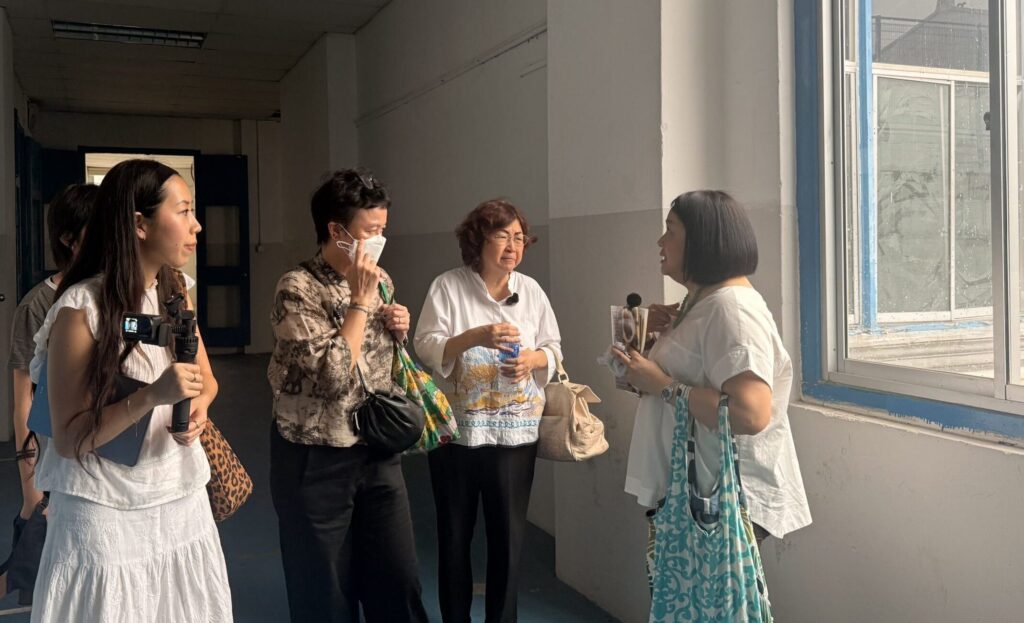
PARTICIPANT SHARING FORMER MEMORIES OF THE CORRIDOR AS A SOCIAL SPACE: STUDENTS WOULD CROWD AROUND OR SIT ON THE FLOOR TO CHAT OR PLAY GAMES [PHOTO: Jamie Loh].
Project Summary
The pilot study, led by researchers from the Social Design Lab (SoDL) and Civic Resilience Lab (CiRe) at the NUS Department of Architecture, is an environmental audit with qualitative GIS methods that aims to document and visualise women’s lived experiences in the city. The environmental audit will develop a new methodology of multimedia journey mapping using an action cam (i.e. GoPro) in the walking interviews. In particular, it investigates women’s experience of safety, security, conviviality, attachment, and comfort through walking interviews taken around the vicinity surrounding the former Singapore Chinese Girls’ School (SCGS) campus at 37 Emerald Hill (37EH), Cairnhill, and the Orchard Road precinct. The fieldwork will focus on how women navigate space, for instance through urban environmental risks, support, personal habits, and coping mechanisms.
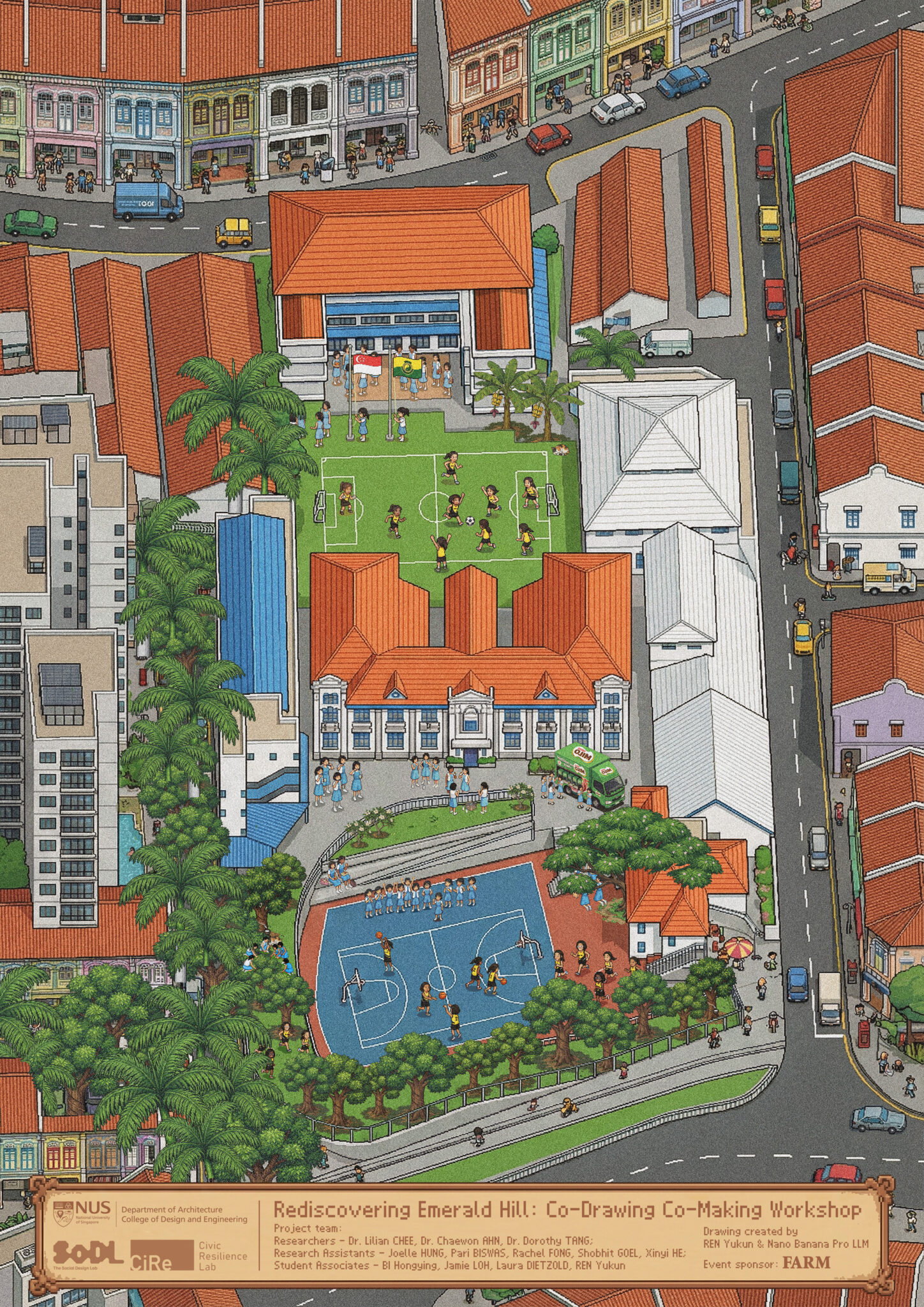
In addition to the walking interviews, Rediscovering 37 Emerald Hill: Co-making Co-drawing Workshop will provide data for the making of a design toolkit that accounts for women’s perspectives of 37 Emerald Hill and its surrounding urban vicinity. The research team plans to submit this toolkit for design research competitions, and to use the pilot as a basis for larger research grant applications.
Rediscovering 37 Emerald Hill is a pioneering, women-centred architectural and creative practice endeavour that foregrounds the social dimensions of space through an interdisciplinary and collaborative approach. Bringing together participants, researchers, designers and practitioners, the project integrates methods from architecture, humanities, social science and the arts—combining walking interviews, collective drawing and co-making as tools of inquiry. Women’s lived experiences, emotions and everyday practices are treated as critical spatial data, revealing how care, safety, memory, and belonging shape the use of place.
By bridging research and practice and working across disciplines and stakeholders, the project demonstrates how architectural knowledge can be co-produced, socially grounded, and transformative, offering a more inclusive and human-centred model for understanding and shaping the built environment. The result is a collaborative co-authored drawing which will be analysed in forward steps after the pilot. The co-authored drawing itself will be showcased in an exhibition.
Methodology
The environmental audit will develop a new methodology of multimedia journey mapping using an action cam (i.e. GoPro) in the walking interviews. The action cam will be worn by the participant, recording footage and audio of their walks. Researchers will accompany the participants as they walk around 37EH site and surrounding areas, with one researcher (Principal Investigator) asking semi-structured interview questions (see sample interview questions) and one researcher (Research Assistant or Student Associate) taking fieldnotes and photographs of the walkalong. The action cam will also geolocate the participants as they move, collecting their coordinates to generate insights about the routes they choose when navigating the city. Photographs and voice recordings will be collected as well for later transcription.
As part of a debrief, additional insights will be captured through documenting participants’ mental maps, anecdotes, and annotations, supplemented with analytical sectional and architectural drawings and photography. Besides academic outputs, the findings will also inform a gender-focused inclusive design guide for architects and planners, which may be published online or in-print. The pilot will test and combine visual and data methodologies, and serve as a first step towards an application for a larger research grant (Tier 2, SSRTG).

PARTICIPANT SHARING MEMORIES OF FORMER BOOKSHOP (NOW COVERED) THAT WAS FRAMED BY TWO KEY STAIRCASES DURING THE WALKING INTERVIEW [PHOTO: Jamie Loh].
Research Outputs
NUS will present findings and an analysis of data to FARM, through a series of static maps aggregating all participants’ data to show the density and intensity of sentiments attached to the places. NUS will also be constructing a pilot design guide from this fieldwork. The collaborative partnership with FARM will result in a broader gender-focused inclusive design guide or toolkit. This pilot project will yield a prototype of such a toolkit, with drawing studies conceptualised and led by NUS, and with in-kind contribution from FARM to realise the pilot document.
Specific Aims
The study aims to create a prototype design toolkit for architects, developers and planners involved in the conceptualisation and design of transient urban commercial and public spaces. The toolkit will prioritise the following: (i) social inclusion and the facilitation of community building through shared communal spaces; (ii) safety and security for women and girls working and living in the area; (iii) the re-introduction of heterogeneous communally-invested spaces in the commercial precinct. Summarily, the design toolkit aims to introduce a socio-spatial construction of knowledge (Anderson, 2004) into the architectural design and decision-making processes.
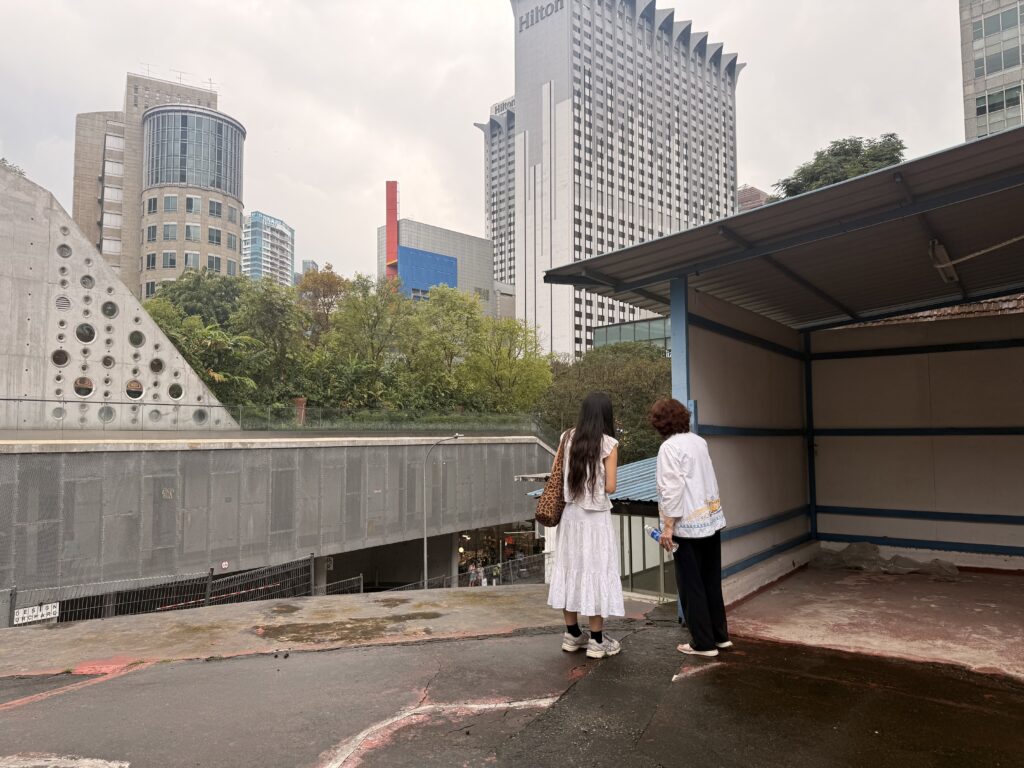
PARTICIPANT RECALLING RARE 3-STOREY SHOPHOUSE TERRACE WHERE DORS AT DESIGN ORCHARD CURRENTLY SITS [PHOTO: Jamie Loh].
Background of Emerald Hill Conservation
In 2018, a group of SCGS alumni launched a campaign titled, ‘Keep 37 Emerald Hill’, that successfully campaigned to conserve their former school campus at 37 Emerald Hill, with 3 unique buildings to be set aside by URA. They published a comprehensive 143-page conservation proposal that included a deep-dive into the historical, social, and architectural significance of the site, as well as a set of preliminary planning and design proposals to reimagine the site for future use. Including a successful 4-month petition that led to 11,476 signatures to URA on change.org. The alumni’s research was based on publicly-available information, as well as outreach and engagement efforts with multiple stakeholders, such as the 37 Emerald Hill Site Tours during Singapore Heritage Festival.
This pilot study takes inspiration from the foundational work done by the SCGS alumni, and seeks to further their research on the site before it undergoes redevelopment. Beyond its heritage value, 37 Emerald Hill offers a lens to understand how women experience and relate to the urban environment.

KEEP 37 EMERALD HILL CAMPAIGN LOGO [PHOTO: KEEP 37 EMERALD HILL].
Collaborators
Civic Resilience Lab (CiRe), National University of Singapore; FARM Architects
Special thanks
This project builds upon the earlier advocacy and community efforts of Keep 37 Emerald Hill and the SCGS Alumni community, whose commitment to memory, heritage and collective stewardship laid the groundwork for this research.