Archival Futures :
At the turn of the twenty‐first century, the resurgent interest among artists in the archive can be attributed to digitalization and the contested meanings of memory, history, heritage and identity. The studio‐seminar course will critically examine the archive’s purpose, role, organization, and underlying assumptions of its authority, power and veracity. It will draw from archival art’s history and contemporary practices to speculate possible archival futures across different scales, media, and influences beyond the art world. Invited speakers, fieldwork, sharing sessions, and site visits complement in‐class readings and lectures.
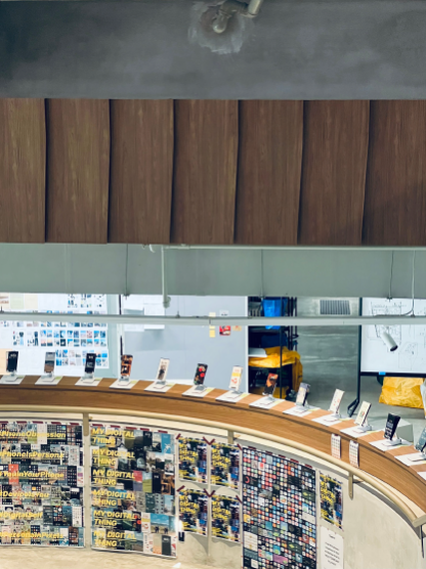
The art-design nexus studio-seminar course offers architecture students an opportunity to traverse disciplinary boundaries. Through readings, engagements with works by artists, designers, urbanists, and cultural practitioners, as well as assigned projects, the course brings critical awareness of the contributions of the arts to the education of an architect.
Learning Outcomes:
- To be aware of the contesting and shifting definitions of the archive.
- To understand the history of archival art and its contribution to art and design discourse and as a critical practice.
- To explore the potential of the archive as a material and spatial intervention comprising of objects, spaces and social relationships.
- To deploy muti-scalar architectural thinking in speculating the various archival futures.
Excerpts from Reading List:
- Brown, Richard Harvey., & Brown, Beth Davies. (1998). The Making of Memories: The Politics of Archives, Libraries, and Museums in the Construction of National Consciousness. History of the Human Sciences. 11(4). 17-32.
- Ansari, Rehan. (2020). Stefanos Tsivopoulos in Conversation with Rehan Ansari. Shelley & Donald Rubin Foundation. https://www.sdrubin.org/blog/2020/3/5/artist-stefanos-tsivopoulos-interviewed-by-rehan-ansari
- Demos, T.J. (2002). Duchamp’s Boîte-en-valise: Between Institutional Acculturation and Geopolitical Displacement. Grey Room. No. 8. pp. 6-37.
- Godfrey, Mark. (2005). Photography Found and Lost: On Tacita Dean’s Floh*. October. 114. 90-119. doi: https://doi-org.libproxy1.nus.edu.sg/10.1162/016228705774889619
- Hiller, Susan. (1994). Working with Objects. In Mereweather, Charles. (Ed.), The Archive. (pp. 41-48). Whitechapel and MIT Press.
- Hung, Wu. (2009). About Waste Not. Things, Memory and Family Ethics. In Waste Not: Zhao Xiang Yuan and Song Dong (pp. 2-19). Tokyo Gallery.
- Kabakov, Ilya. (1997). The Man Who Never Threw Anything Away. In Mereweather, Charles. (Ed.), The Archive. (pp. 32-37). Whitechapel and MIT Press.
- Warhol, Andy. (1997). The Philisophy of Andy Warhol. In Mereweather, Charles. (Ed.), The Archive. (pp. 31). Whitechapel and MIT Press.