Exhibitor Lineup:
05/03/2026
John K.C. Liu &
Mu Szu Mien;
Tan Beng Kiang;
Emmanuel Pratt;
Pangrok Sulap;
Ou Ning;
Barofspace;
Charis Poon &
Chan Kam Fai;
Edit Collective;
Community Architects Network (Witee Wisuthumporn & Mahmuda Alam);
Community Maintenance Club;
Parsons And Charlesworth;
Peggy Deamer
EXHIBITION TEAM
Thomas Tsang, Thomas Kong, Co-Curators; Alison Liew, Faith Yeo, Humairah Sumaiya, Jamie Foo, Jamie Loh, Lee Chu Xin, Lee Yeling, Lee Zhuo Yao, Liu Zepu, Sabrina Law, Student Associates
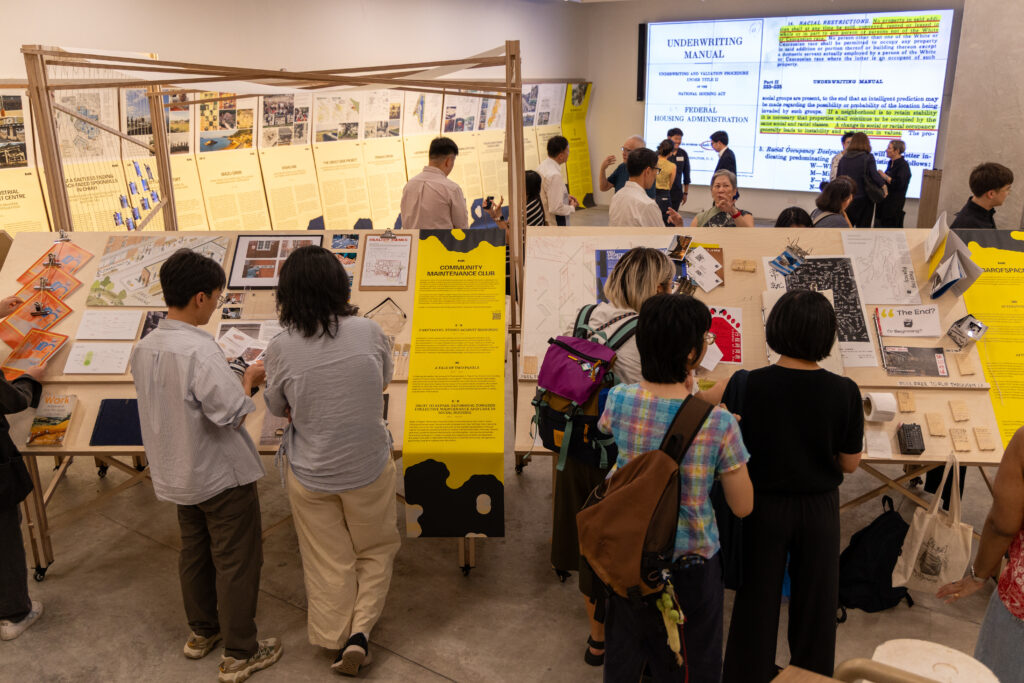
Assembling the Social exhibition brings together a multidisciplinary collection of fourteen socially-engaged projects. Read more about the exhibitors here.
Relevant Links
Read more on Exhibition: Assembling the Social →The Foundation’s mission is to provide research, planning and design services to public agencies in solving critical environmental issues. Over the past 35 years, the Foundation has completed more than 600 projects in Taiwan as well as on Mainland China, Central Asia and Central America. The Foundation operates as a not-for-profit organization within the university staffed by multidisciplinary professionals in conjunction with graduate students in the masters and PhD programs. In all of the projects, a core objective is the active social engagement of user groups and stakeholders in the decision making process.
A senior planner and designer, he served as Executive Director of the BPRF from 2002 to 2005. Over the past three decades, he has been involved in major planning and design projects, including the Lanyang Museum in Yilan, ecological conservation and community-based ecotourism planning for the Black-faced Spoonbill habitat along Taiwan’s south-west coast, and post-disaster cultural industry center design for Indigenous communities in Rinari, Pingtung.
Her teaching and research focus on participatory design and planning, ageing, and housing. She was inducted as a Fellow of the National University of Singapore Teaching Academy in 2021 in recognition of her contributions to architectural education. A recipient of multiple teaching and design awards—including the Pacific Rim Award for Excellence in Public Interest Design (2018) for the Smile Village Project—she has served as a council member of the Singapore Institute of Architects and sits on national committees. Dr. Tan holds a doctorate from Harvard University, a Master of Architecture from UCLA, and a Bachelor of Architecture (Honours) from the National University of Singapore.
In 2016, Pratt was named a Loeb Fellow at Harvard University’s Graduate School of Design. He was the Joyce Award recipient and a MacArthur Fellow in 2019. Pratt is currently the co-founder and Executive Director of the Sweet Water Foundation in Chicago, and sits on the Advisory Council of the NeuroArts Blueprint Initiative.
This diversity enriches the collective discipline and in turn makes the collective more dynamic. Thus, benefiting itself to run various activities and programs. Along with the collective’s mission to strengthen the community through art, they have organised art exhibitions, projects and collaboration with multiple communities for the development of social, culture, economic and education. Since 2013, Pangrok Sulap has participated in various art exhibitions locally and globally. In addition, they have been actively involved with many community projects, forums, workshops and art studies. Some of the collective works have become collections of museums and galleries such as Mori Art Museum (Japan), Singapore Art Museum (Singapore) and Queensland Art Gallery (Australia).
He directed the documentaries San Yuan Li and Meishi Street, which examine the transformation of urban space in contemporary China. In the field of exhibition-making, he served as chief curator of the 2009 Shenzhen & Hong Kong Bi-City Biennale of Urbanism\ Architecture and sat on the jury for the 8th Benesse Prize at the 53rd Venice Biennale. He has also contributed to global discourses on art and cities as a member of the Asian Art Council at the Guggenheim Museum. Parallel to his curatorial and cinematic practice, Ou Ning founded the influential literary journal Chutzpah! and initiated the Bishan Project, a long-term, rural reconstruction experiment that explores alternative forms of community and cultural production. His engagement with pedagogy and research includes teaching at Columbia University’s Graduate School of Architecture, Planning and Preservation (GSAPP) and holding a research position at the Center for Arts, Design and Social Research in Boston.
They draw on their background in architectural education to explore wider spatial phenomena, everyday spaces, and critically re-examine production-oriented modes of learning and practice through collective exploration.
Charis worked as a freelance graphic designer and editor for most of her professional career, as well as working in creative strategy and podcasting. After finishing her MA in Design Expanded Practice at Goldsmiths University of London, she moved back to Hong Kong, where she calls home. Now, she teaches Social Design at the PolyU School of Design. She is interested in poetics in communication, learning through making, slow growth, and collective endeavors.
He organizes several independent schooling and publishing projects in Hong Kong, including Omnia Omnibus and Mundi, collaborating with local collectives and research groups and speculating on contemporary biopolitics and social matters.
They are architects, project managers, set designers, tutors and researchers and have combined experience across projects of all scales and stages. Their work has been exhibited at the 2019 Oslo Architecture Triennale, MAXXI in Rome, the Design Museum, Akademie der Kunste and during the London Design Festival, among others. Their clients include the Barbican Centre, Science Gallery London, Camden Council, Farrell Centre and People’s Museum Somers Town. Edit was nominated for Manifestos: Architecture for a New Generation, highlighting emerging voices shaping architecture in London, and have recently been featured in the RIBA Journal Future Winners, and Architects’ Journal Architectural Antagonists.
Complementing CAN’s showcase, this exhibition highlights works of CAN coordinators: Witee Wisuthumporn (Muang) is a Thai community architect, CAN Thailand coordinator, and co-founder of CROSSs, a firm dedicated to social and participatory design. He collaborates with communities and stakeholders to co-create inclusive spaces rooted in collective aspirations, emphasizing togetherness and design processes that foster communication and empower people to shape their own solutions. Mahmuda Alam is a Bangladeshi architect with 12 years of experience in community architecture, particularly housing and settlement planning. She co-founded the Platform of Community Action and Architecture (POCAA), leads young architects in developing low-income housing and neighborhood enhancements in Dhaka, and has consulted on research projects with INGOs. A CAN coordinator since 2020, she focuses on urban resilience and community health through place-making.
Working closely with the local community on the Boundary Estate in Shoreditch, London, the initiative started by sharing the idea with the residents that, by involving them in low-level repairs and maintenance, and making use of the skills of people living on or near the estate, it could create active community involvement in the upkeep, retrofit, and future use of local housing. The research, titled “Right to Repair: Reforming Towards Collective Maintenance and Care in Social Housing,” is currently supported by RIBA Research Fund, co-led by Rosy Wing Nga Tam and Spike Zhuo Chen. Rosy Tam is an architectural designer, who is passionate about circular economy, materiality and community involvement in architecture. She holds a Master of Architecture with Commendation from the Architectural Association, having previously studied at the Chinese University of Hong Kong. Spike Chen is an architectural designer and documentary photographer. He is interested at the connection between everyday life and ways of production. He holds a Bachelor and Master of Architecture from the Architectural Association. His work has been exhibited at the Royal Academy of Arts and the Venice Biennale.
Working with media including cast resins, woven willow, bent metal, inflatable PVC, molded fabrics and ready-mades they transform conventional materials into artifacts from imagined futures that feel both strange and familiar. Rather than offering utopian solutions, their work creates spaces where uncomfortable questions can surface. Their practice ultimately serves as a mirror, reflecting our collective anxieties and desires about what lies ahead and how we might chart a more just and enlightened future.
She is a founding member of The Architecture Lobby (TAL), a group advocating for the value of architectural labor. She is the editor of Architecture and Capitalism: 1845 to the Present and The Architect as Worker: Immaterial Labor, the Creative Class, and the Politics of Design and the author of Architecture and Labor. Her theory work explores the relationship between subjectivity, design, and labor. She received the Architectural Record 2018 Women in Architecture Activist Award and the 2021 John Q. Hejduk Award.